01
Verbatim copying
Reproducing another author's exact words without quotation marks or citation, even a single sentence.
The Merituss Plagiarism Checker names what plagiarism is in the AI era, surfaces it with source-linked evidence, and turns each finding into a teaching moment, not a verdict.
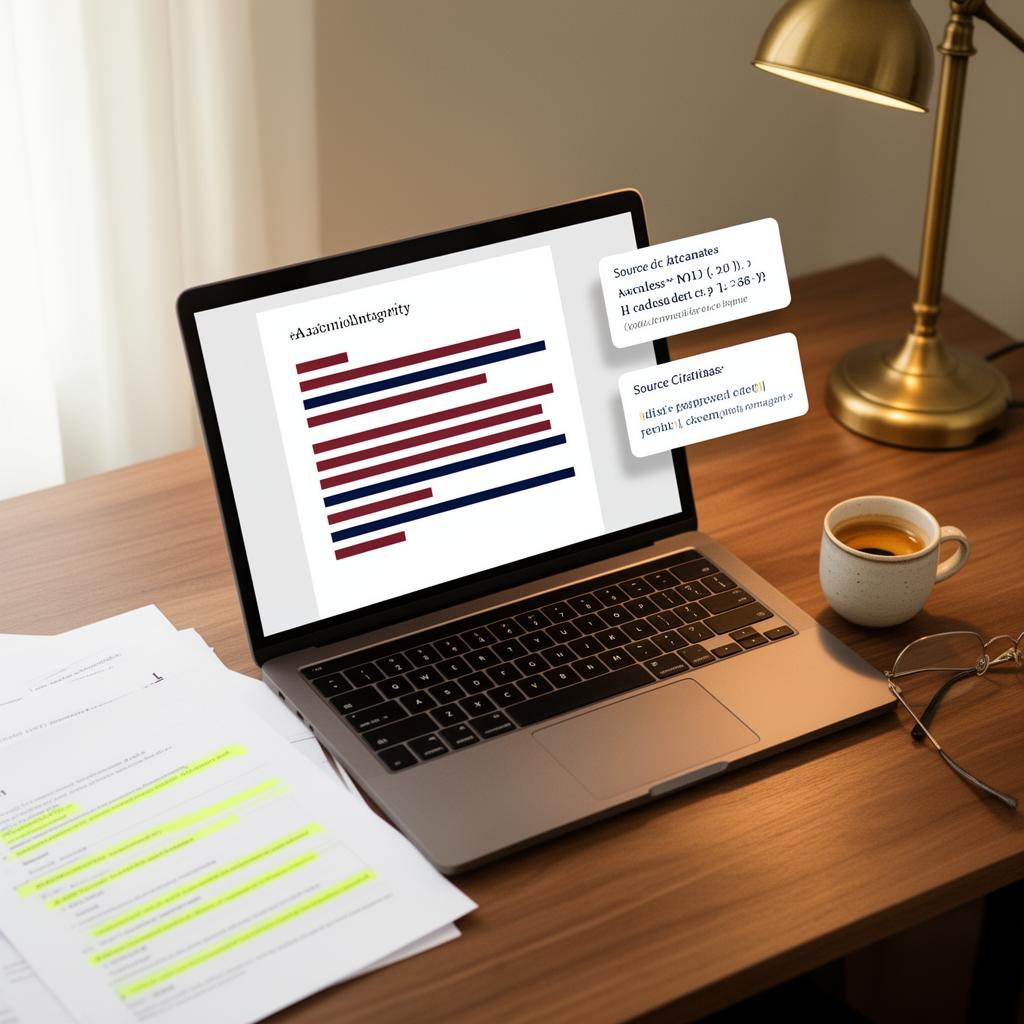
Plagiarism is presenting any work, language, ideas, structure, data, or imagery, as your own when it originated elsewhere, without honest attribution. It is not defined by intent alone; the absence of citation is enough to mislead a reader.
In 2026, that "elsewhere" includes generative models. Asking a chatbot to draft a paragraph and submitting it unedited is not collaboration, it is uncredited authorship. The principle is unchanged: name your sources, human or otherwise.
"Originality is not isolation, it is acknowledged influence."
Plagiarism rarely arrives as a clean copy-paste. Most cases sit on a spectrum, half-cited, half-paraphrased, half-AI. Naming the pattern is the first step to addressing it.
Reproducing another author's exact words without quotation marks or citation, even a single sentence.
Stitching together phrases from multiple sources and presenting the patchwork as original prose.
Rewording a source's argument or structure without crediting the original author.
Resubmitting your own previously graded work, in whole or in part, without instructor approval.
Citing a real source while misrepresenting what it says, or citing a source that does not exist.
Outsourcing the work, paid or unpaid, to a friend, an essay mill, or a freelancer.
Passing off model-written text as your own without disclosure or substantial editorial contribution.
Running a source through a model or 'humanizer' to mask its origin while preserving the argument.
Translating another author's work into a new language and submitting it as original.
Co-writing an assignment that was meant to be individual, blurring authorship in the process.
Most plagiarism is not malicious. Understanding the conditions that produce it is what turns a disciplinary problem into a curriculum design opportunity.
Deadlines, grades, scholarships, visas. Students under load reach for the closest shortcut, especially when the rules feel ambiguous.
When a syllabus does not name what counts as collaboration or AI use, students fill the silence with their own definition.
Citation is a craft. Many students have never been taught to paraphrase responsibly or build a reference list under time pressure.
Generative models, paraphrasers, and essay mills are one tab away. Friction has collapsed; intention has to do more work.
A repeatable loop institutions use to address plagiarism without turning every classroom into a courtroom.
Publish a one-page integrity expectation per course, including AI use, before the first assignment is due.
Run submissions through Merituss Similarity to surface source matches, AI-likely passages, and writing-process anomalies in a single report.
Treat the report as evidence for a conversation with the student. Distinguish citation slip-ups from intent before escalating.
Use anonymized patterns from prior cohorts to redesign prompts that reward analysis over paraphrase, and disclosure over deception.
A live integrity check on synthetic data: matched sources, AI-authorship signal, and an editor's note. Nothing leaves your browser.
Most disputes start with a misunderstanding of what plagiarism actually is. Set these straight in your syllabus and you will prevent the majority of cases.
"If I change a few words, it is not plagiarism."
Paraphrase without attribution is still plagiarism. Credit the source whose argument or structure you borrowed.
"Common knowledge does not need a citation."
True for widely accepted facts (water boils at 100°C). False for any specific claim, statistic, or framing tied to a particular source.
"If the AI wrote it, no human is being plagiarized."
Authorship is what is being misrepresented. Submitting model-written work as your own breaks the disclosure that grading depends on.
"A low similarity score means the work is original."
Similarity reports show overlap with known sources. They do not measure thinking, ideas, or paraphrased structure on their own.
We stopped framing plagiarism as a hunt and started treating each report as a teaching artifact. Our integrity cases dropped by half in two semesters.